







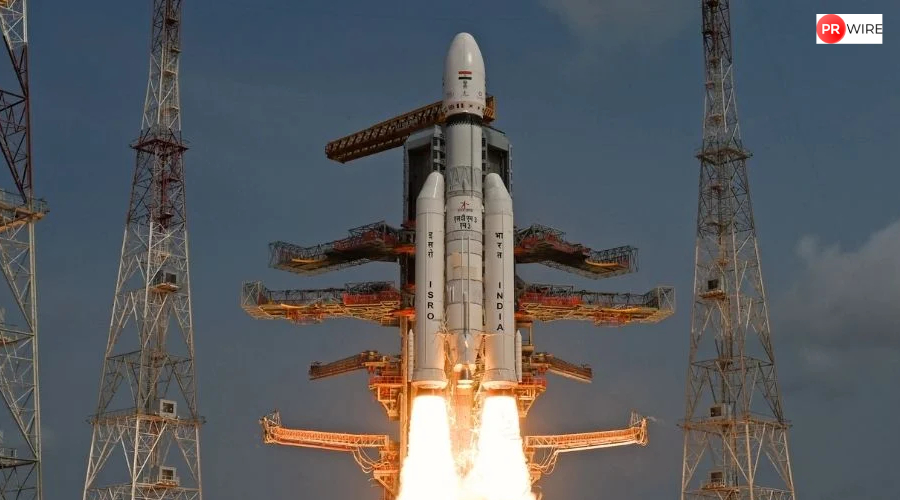
The launch is significant as the Bluebird Block-2, weighing 6,100 kg, is the heaviest payload ever placed into Low Earth Orbit (LEO) by ISRO’s LVM3 rocket.
The Indian Space Research Organisation (ISRO) on Wednesday launched the Bluebird Block-2 spacecraft of US-based AST SpaceMobile onboard its heavy-lift launch vehicle LVM3-M6, a ‘Baahubali’ rocket, in what is being seen as a milestone for the space agency’s commercial push. The spacecraft lifted off at 8.55 am on Wednesday from the launch pad at the Satish Dhawan Space Centre in Andhra Pradesh’s Sriharikota.
The satellite was later successfully placed into the orbit, according to the space agency.
WATCH:
#WATCH | Sriharikota, Andhra Pradesh | ISRO’s LVM3 M6 mission lifts off from the Satish Dhawan Space Centre, carrying the BlueBird Block-2 satellite into orbit, as part of a commercial deal with U.S.-based AST SpaceMobile.
The mission will deploy the next-generation… pic.twitter.com/VceVBLOU5n
— ANI (@ANI) December 24, 2025
The launch is also significant for ISRO as the Bluebird Block-2, weighing 6,100 kg, is the heaviest payload ever placed into Low Earth Orbit (LEO) by the space agency’s LVM3 rocket.
PM Modi, Union minister hail ISRO launch
Prime Minister Narendra Modi hailed the launch and said that it reflects “our efforts towards an Aatmanirbhar Bharat”.
In a post on X, Modi wrote, “A significant stride in India’s space sector…The successful LVM3-M6 launch, placing the heaviest satellite ever launched from Indian soil, the spacecraft of USA, BlueBird Block-2, into its intended orbit, marks a proud milestone in India’s space journey. “
A significant stride in India’s space sector…
The successful LVM3-M6 launch, placing the heaviest satellite ever launched from Indian soil, the spacecraft of USA, BlueBird Block-2, into its intended orbit, marks a proud milestone in India’s space journey.
It strengthens… pic.twitter.com/AH6aJAyOhi
— Narendra Modi (@narendramodi) December 24, 2025
He added, “This is also reflective of our efforts towards an Aatmanirbhar Bharat. Congratulations to our hardworking space scientists and engineers. India continues to soar higher in the world of space!”
Union minister of state (independent charge) for science & technology Dr Jitendra Singh congratulated the team at ISRO for the successful launch, saying that the space agency continues to “achieve one success after another”.
“Kudos Team #ISRO for the successful launch of LVM3-M6 carrying BlueBird Block-2. With the visionary patronage of PM Narendra Modi, ISRO continues to achieve one success after another, reiterating India’s growing prowess in Space technology,” he wrote on X.
Why ISRO’s Bluebird Block-2 launch is significant
The mission is being carried out as part of a commercial agreement between ISRO’s commercial arm NewSpace India Ltd (NSIL) and US-based AST SpaceMobile, also known as AST and Science LLC.
At 6,100 kg, this is the heaviest payload to be placed by ISRO’s heavy-lift launch vehicle LVM3. The previous record was held by the LVM3-M5 Communication Satellite-03, which weighed around 4,400 kg and was successfully launched by ISRO on November 2 into the Geosynchronous Transfer Orbit (GTO).
It is also worth noting that the mission seeks to provide high-speed cellular broadband directly to smartphones worldwide by placing the next-generation communication satellite in orbit.
US-based AST SpaceMobile is developing the first space-based cellular broadband network that connects directly to regular smartphones. The network is intended for both commercial and government use and will support 4G and 5G voice and video calls, messaging, streaming and data services across the globe.
All you need to know about ISRO’s LVM3 vehicle
The 43.5-metre-tall LVM3, also known as the Geosynchronous Satellite Launch Vehicle (GSLV) Mk III, is a three-stage rocket. It uses a cryogenic engine designed and developed by ISRO’s Liquid Propulsion Systems Centre, according to the space agency.
The vehicle is fitted with two S200 solid rocket boosters that provide the high thrust needed for lift-off. These boosters were developed by the Vikram Sarabhai Space Centre in Thiruvananthapuram.
In previous missions, the LVM3 has successfully launched Chandrayaan-2, Chandrayaan-3 and two OneWeb missions that together carried 72 satellites.
The article originally appeared on Hindustan Times