














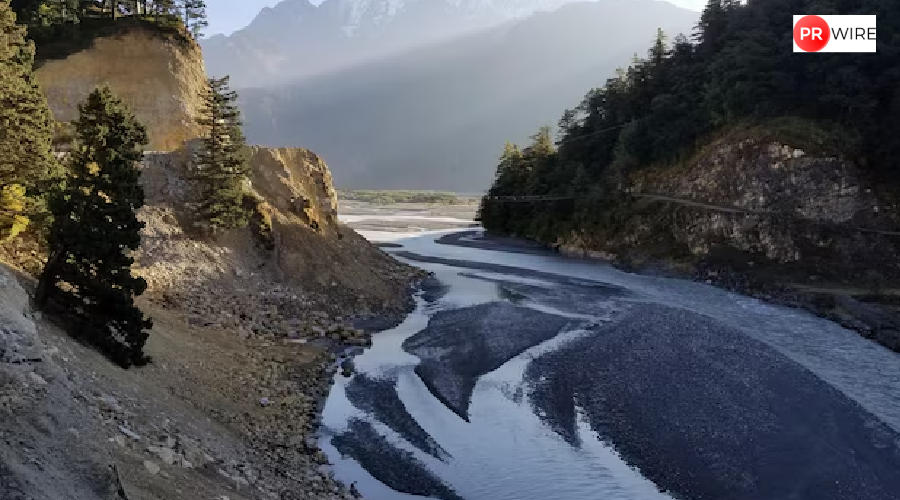
Kashmir faces water crises due to climate change and the 1960 Indus Waters Treaty. Farmers demand fair water distribution amid rising temperatures.
Last spring, water came rippling through a section of a British-era canal and submerged Riyaz Ahmed Bhatt’s mustard crop at Sangri Top Watlab, a breathtaking locale overlooking the jagged Pir Panjal mountain peaks in Kashmir’s Baramulla district.
The following summer blasted a heat wave through Bhatt’s eight-acre farm, shriveling his next crop, a popular rice variety called Shalimar. This year, Bhatt has sown rice again, but there’s hardly any water flowing through the carriageway that is supposed to irrigate most of the valley. Experts have linked Kashmir’s hotter summers to the climate crisis.
As water crises mount, the valley’s residents say they are finally hopeful of getting a fair share of key rivers flowing through Kashmir following India’s decision to suspend the 1960 Indus Waters Treaty with Pakistan, a move that came after a deadly terror strike in the region’s Pahalgam area on April 22.
Under the treaty, total water from the six Indus rivers is shared in the ratio of 80:20 between Pakistan and India. The pact allocates the Indus, Jhelum and Chenab, known as the western rivers, to Pakistan and the Ravi, Beas and Sutlej, or the eastern rivers, to India. According to India, natural and climate-change induced changes in the Indus basin itself had diminished India’s share amid a rising population.
Srinagar, once a cool high-altitude station, now sees scorching summers and endless cycles of power cuts, as the Union Territory has turned a net buyer of electricity despite a string of hydropower projects, a grievance aired by many.
The cultivation of Kashmir’s famed saffron, the world’s costliest spice, which depends on rains, has shrunk due to inadequate irrigation facilities. Sprinkler-based irrigation lines launched under an ambitious project in 2010 are inactive in over 60% of the area covered under the scheme, according to a status report submitted to the Centre in 2021.
“These changes have intensified a feeling that Jammu & Kashmir has always lost out on its rightful share of water and power because of both the water treaty and also because bulk of power generated from the state’s rivers is sold in the open market to other states,” said Tanveer Hussain, a former top bureaucrat of the Union Territory.
Last year, there was no precipitation in the first half of January, which followed an 80% deficit in December rainfall, crucial for apples, mustard and a host of horticulture crops, which account for 40% of the state’s farm produce, data from the India Meteorological Department show.
About 10 km downstream of Bhatt’s rice farm, Sajid Mir, a part-time apple trader and part-time farmer, says that last year, the district administration arranged for water supply through tankers. The 50-year-old said this was the first time his village had seen a drinking-water crisis. Mir said he had a poor mustard crop like his neighbours, as seasonal rainfall departure from normal between October 1 2024, and February 28 2025, was -74%.
“The government in Delhi should give first priority to our water needs. It can give water to other states or Pakistan only after our needs are met. Pakistan’s farmers have always got more water from our rivers,” Mir said.
In April, soon after India pulled the plug on the water pact, Jammu & Kashmir’s chief minister Omar Abdullah called the treaty the “most unfair document imposed on the people” of the Union Territory, a view echoed by business owners too.
In Srinagar’s Residency Road area, one of the city’s main shopping districts, 65-year-old hotelier Farooq Dar recalled how his late father, Maqbool Dar, predicted future water crises. “In the 90s, my father drafted a representation on behalf of the Kashmir Chamber of Commerce and Industries to the state government about water shortages faced by the industrial sector. The petition mentioned the unfair distribution of water under the Indus Treaty.”
A changing climate has made winters harsher and summers drier, impacting both agriculture and local businesses. Kashmir’s winters have been historically divided into three phases. The first phase, called Chillai Kalam, is usually the coldest, followed by Chillai Khord, the second phase. The winter tapers off with a mild phase known as Chille Bachi.
“The Chillai Kalam is when most of the snowfall takes place, but there has been a decline in snow over the years,” said Mukhtar Ahmed of the local Met bureau. Similarly, erratic rainfall patterns have forced paddy growers to shift to fruit orchards.
Last year, there was hardly any snow in Gulmarg, Asia’s largest ski terrain, popular with tourists and skiing enthusiasts. Only 13% of the total power generated inside the Union Territory is available for Jammu and Kashmir despite huge potential for hydropower, a bureaucrat said, requesting not to be quoted.
About 70% of Kashmir’s population depends on farming, and mountain cultivators depend on snowmelt for irrigating their crops. But hotter summers have caused glaciers to melt too fast or early, which has made water supply as well as farming difficult, said Farhat Amin, an agronomist with the Sher-e-Kashmir University of Agricultural Sciences.
“The Indus Waters Treaty is seen as an international issue, but its biggest impact has been on us. It was unfair for us, and this wrong should now be corrected,” said Ambreen Shaikh, a teacher at Presentation Convent School.
The article originally appeared on Hindustan Times